How to Read Sonar: Beginner to Advanced Guide for Anglers
Learning how to read your sonar is the fastest way to find fish and catch more consistently. Whether you’re a beginner or experienced angler, understanding what your fish finder shows is critical. This summary will teach you how to interpret sonar images, identify fish, distinguish weeds and structure, and avoid common mistakes that cost you fishing time.
By the end of this summary, you’ll know:
How to read 2D and CHIRP sonar arches
How Side Imaging and Down Imaging work
How to spot fish versus structure and weeds
Simple tricks to avoid beginner mistakes
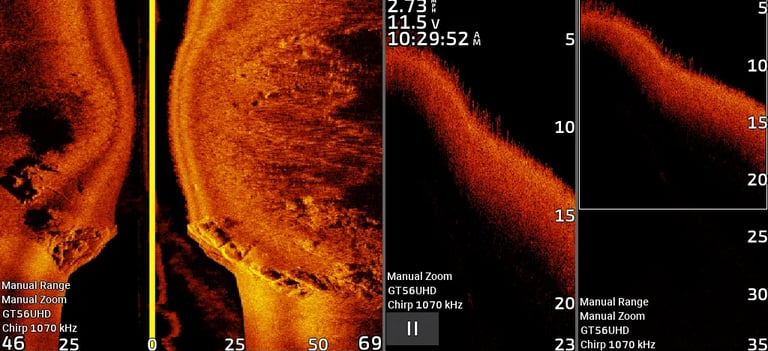
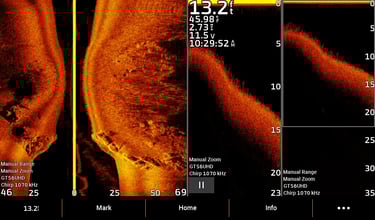
Side imaging and down imaging sonar showing bass suspended over weeds
SECTION: SONAR BASICS
Sonar works by sending sound waves into the water and reading the echoes that bounce back. Most modern fish finders display this as arches or shapes on the screen. Understanding the different sonar types is key:
2D / CHIRP sonar: Shows fish as arches and lets you measure depth accurately.
Side Imaging (SideVü): Scans large areas to the left and right of the boat, giving a picture of structure and fish.
Down Imaging (ClearVü): Provides detailed images directly under the boat for precise structure mapping.
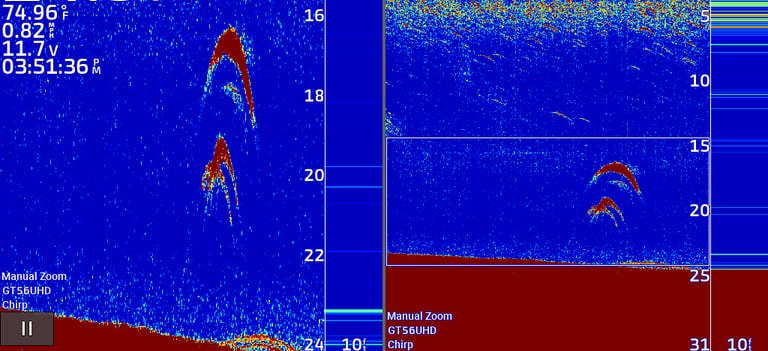
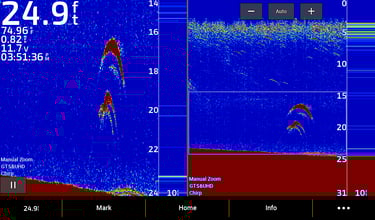
2D CHIRP sonar arches showing suspended bass above bottom
SECTION: HARD VS SOFT BOTTOM
The bottom type affects fish behavior and how sonar returns appear on your screen.
Hard bottom (rock, sand): Shows a strong, bright return. Fish near hard bottom are often more concentrated.
Soft bottom (mud, weeds): Shows a faint or fuzzy return. Fish may suspend higher above the bottom.
Adjust your sensitivity (gain) to avoid clutter and to better see fish and structure.
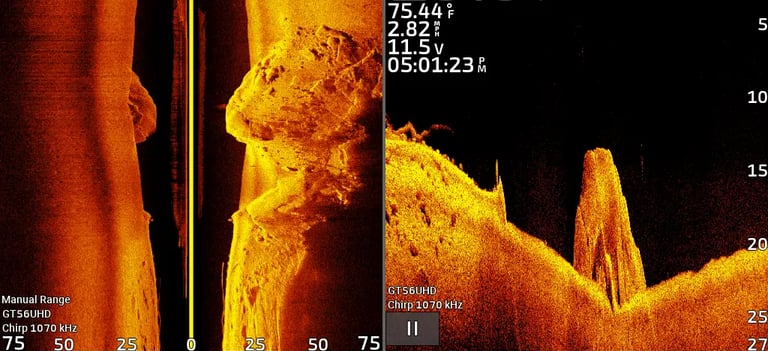
Side imaging sonar showing hard (right) and soft (left) bottom returns
SECTION: FISH VS STRUCTURE VS WEEDS
Distinguishing fish from weeds or underwater structure is essential.
Fish: Arches or small blobs, often moving. Suspended fish may cast a shadow on the bottom in Side Imaging.
Weeds / vegetation: Fuzzy or tall vertical marks, often connected to the bottom.
Structure (rocks, logs, drop-offs): Solid, defined shapes connected to the bottom.structure.
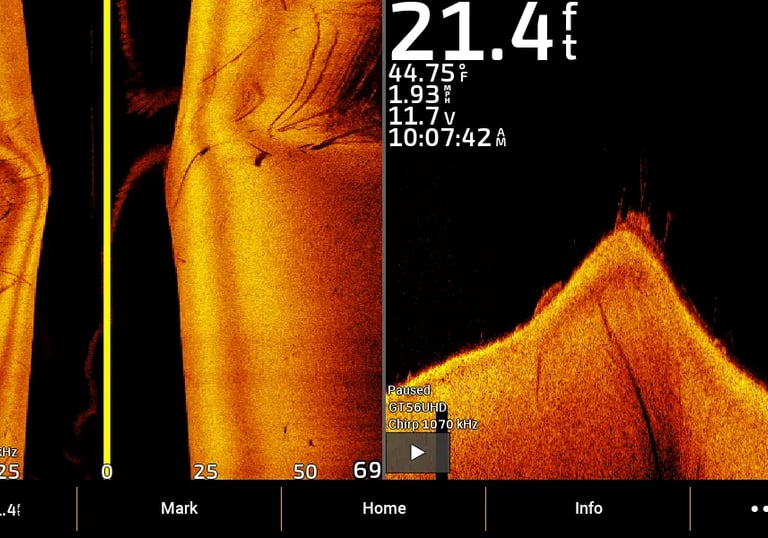
Bass suspended above weeds. Side Imaging(right) and down image sonar (left).
SECTION: HOW TO IDENTIFY SUSPENDED FISH AND SHADOWS
Suspended fish appear off the bottom and often create shadows. Shadows help estimate fish size and position. Side Imaging is especially useful for spotting suspended fish along weed edges, drop-offs, and humps.
Suspended fish casting shadow on lake bottom, on side imaging sonar (left).
SECTION: COMMON SONAR MISTAKES BEGINNERS MAKE
Many anglers misread their sonar and miss fish. Avoid these mistakes:
Too much sensitivity: Creates clutter, hard to see fish.
Chasing single arches: Not every arch is a fish; learn patterns.
Misreading bait: Small marks may be minnows, not bass or trout.
Wrong speed: Too fast or too slow distorts images.
SECTION: SONAR SETTING AND TIPS
CHIRP / 2D: Use low frequency for deep water, high frequency for shallow water.
Side Imaging: Keep boat speed moderate (3–5 mph) for best results.
Down Imaging: Best for vertical jigging or tight structure areas.
Link:
Side Imaging Setting and Best Value for Bass
Frequency: 455 kHz (search) / 800–1000+ kHz (detail)
Boat Speed: 3–5 mph (5–8 km/h)
Side Range: 2–4× water depth
Sensitivity:65–75%
Contrast:Medium to High
Scroll Speed:Match boat speed (or Auto)
Color Palette:Amber / Sepia / Blue
Take Your Sonar Skills Further
Stop guessing and start catching more fish. Book hands-on sonar training and learn directly on the water with a professional guide.